



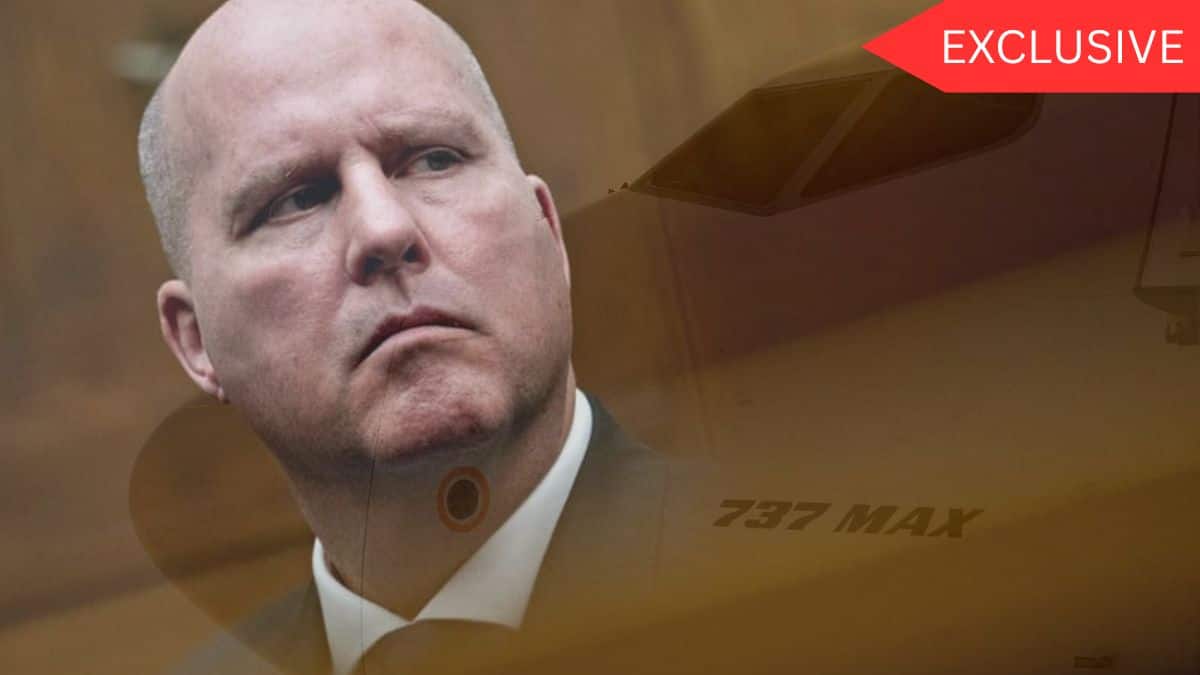
The tragic Ahmedabad plane crash on June 12 has once again put Boeing’s Dreamliner under the safety spotlight. Former Boeing senior manager-turned-whistleblower and current executive director of the
Foundation for Aviation Safety, Ed Pierson, has sounded the alarm on aircraft quality and flagged serious defects in manufacturing and production.
Speaking to Firstpost, Pierson said that while Boeing publicly claims safety and quality come first, that is not what plays out on the factory floor. “
Schedule was king,” he said, adding that intense pressure and fatigue among workers led to repeated mistakes.
Pierson also rejected the pilot-error narrative, calling the
787 Dreamliner an “electrical monster.”
The executive director of the Foundation for Aviation Safety raised grave concerns about the direction of the investigation. Describing the Aircraft Accident Investigation Bureau’s (AAIB) preliminary report as horrible, Pierson said it omitted crucial information, including sensor data, stabiliser details and the full cockpit voice recording (CVR). He also lauded the Supreme Court’s intervention in the matter.
Edited excerpts:
Firstpost: You spent nearly a decade at Boeing, including senior roles inside the 737 and 787 programmes. What did those years tell you about Boeing’s production culture and quality control systems?
Ed Pierson: Boeing is world-renowned for its quality control. It has been that way for decades. During my first job at Boeing, I was rudely awakened because I was working on software development for the 787 programme. I was working with a team of people and found that those responsible for developing the software were not being honest with senior executives.
We then did the entire audit work, and that was my introduction to the varying culture of quality control. I was initially overwhelmed by the complexity of the gigantic site. I was on a learning curve. It took me about a year before I started realising that there were some serious quality-control issues inside the factory.
Firstpost: When did you first notice production pressure or safety shortcuts that troubled you? Was there a moment when you realised internal warnings were no longer enough? Why did you become a whistleblower?
Ed Pierson: I didn’t want to become a whistleblower. I was working with my team and other teams. I witnessed an inordinate amount of pressure being placed on manufacturing, quality control and supply-chain employees at the factory.
Schedule was king, as they always say at Boeing. Publicly, they say safety and quality come first, but when it gets down to brass tacks, unfortunately, it varies widely on the factory floor. Some teams work at a very high level of quality control, while another team, led by a different group of people, makes the wrong decisions.
Firstpost: On the Ahmedabad plane crash on June 12, 2025, you speak of a pattern of issues at Boeing. What recurring problems do you see in production, documentation or oversight?
Ed Pierson: When a plane is built, inspections occur, and those inspections are designed for specific monitoring because people have made mistakes — and anybody can make a mistake.
Employees were being asked to work ridiculously long hours. We began seeing quality-control reports showing issues primarily with flight-control systems, electrical systems, hydraulic systems and pressurisation. It covered everything — a wide gamut of issues.
Nothing is fully automated. These airplanes are built by people. We saw human factors — people being exhausted, making mistakes, arguing, and communication breakdowns. We’re building airplanes; it cannot be done this way. One of the things that jumped out at me was functional test failures.
These are system-wide tests designed to prove that everything is working, and we saw them failing. There were supply-chain problems. Parts were not being delivered on time. We got into a pattern of out-of-sequence work. Employees would wait for parts, and if they didn’t arrive, the work got pushed to the next flow day, disrupting everything. In the end, employees rushed to install parts and finish work. It was downright dangerous.
We’ve been asked to testify before Congress a couple of times. We saw similar patterns during the development of the 787. There were serious problems when the plane was first built — what they call the “terrible teens”. A couple of dozen very bad airplanes that required extensive rework. There’s a long history of manufacturing quality-control issues.
Firstpost: On the day of the fatal crash, the same Dreamliner — but a different aircraft, Air India 423 — reportedly had a hard landing, with the crew flagging tail-stabiliser alerts. The AAIB said engineers carried out troubleshooting and cleared the aircraft. Does that concern you?
Ed Pierson: I’ve heard about that report. There was a sensor in the back of the plane — a horizontal stabiliser sensor transducer — that wasn’t working. There’s an audio recording from the pilots, and they released only a teeny-tiny portion of it. It was certainly implied that the pilots deliberately made a mistake, and we take great issue with that.
There’s also a data recorder that tracks everything pilots see on their instruments. None of that was included in the preliminary report. There’s ACARS, a text-based data-link system that sends information between the aircraft and maintenance centres. There was no information about that either. Another system, AHM, is designed to collect and transmit real-time data.
The aircraft impacted the BJ Medical College hostel about 1.6 kilometres from the end of the runway. ReutersWe found the preliminary report to be honestly horrible. It was a terrible report. What was stunning was the outright withholding of critical information people should know. Before blaming dead pilots, investigators need to examine all possible faults and failures. We know the 787 has a history of problems.
Firstpost: There have been media reports, including in the Wall Street Journal, repeatedly hinting at pilot error while the investigation is still ongoing. What do you make of that?
Ed Pierson: In one word, it was disgusting. We read the Wall Street Journal report and felt like we were reading a magazine with no credibility. Coming from the Wall Street Journal, it was shocking.
Late Captain Sumeet Sabharwal. Image courtesy: XThe reporter was going along with the narrative pushed by US authorities. The initial AAIB investigation team didn’t include pilots, which is questionable. This aircraft is incredibly complex. Why wouldn’t investigators draw on global expertise?
We believe a new accident-investigation process is needed. There’s too much political interference and conflict of interest. Information is being selectively released.
There’s been a lot of discussion about the fuel cut-off switch. From my experience, these switches can fail and send incorrect signals. This 787 — I call it an electrical monster. It is incredibly complex, with multiple power panels and circuits. It’s a very complicated aircraft.
Firstpost: AAIB investigators are set to meet the NTSB in Washington, with Boeing representatives present. What do you expect from that meeting?
Ed Pierson: I once held the NTSB in very high regard. They had a strong reputation and deep forensic expertise. But since the MAX crashes in 2018 and 2019, we’ve seen a horrible deterioration.
The NTSB is a small organisation — around 450 employees — yet it investigates all major transport accidents: aviation, rail, maritime, pipelines and more. They are overly dependent on Boeing. We provided documentation showing the second MAX aircraft had electrical failures before it crashed, and Boeing knew it. The NTSB refused to pass that information to investigators.
There’s a lot of talking in front of cameras. Sometimes it feels like a self-licking ice-cream cone. We’re not expecting much. In India, the Supreme Court is stepping in, and we applaud that.
Firstpost: On cases such as the Ethiopian Airlines 737 MAX crash and EgyptAir 990, foreign authorities felt US investigators prematurely blamed pilots and overlooked mechanical issues. Do you see a pattern?
Ed Pierson: I’m aware of the Egyptian accident, and I’m familiar with the MAX crashes. There is a pattern. Right after an accident, there are condolences and promises, and then immediately, pilots are blamed. There’s an effort to protect the same parties under investigation.
Boeing 737 MAX. ReutersIf an airline had maintenance issues, that may have contributed. If a manufacturer has historical manufacturing problems, that information is also suppressed. There’s criminal liability, financial ramifications and reputational damage. The stakes are very high. The accident-investigation process is outdated and does not match modern aircraft complexity.
Firstpost: Would you personally fly on a 787 or a 737 MAX today?
Ed Pierson: No. I will not fly on the 737 MAX. We have extensive defect reports on our Foundation for Aviation Safety website. There are engine load-reduction device issues that cause smoke in the cabin and cockpit. There are anti-icing problems that could cause cowling disintegration. There are many issues.
We’re completing an analysis of the 787, and there are enough similarities. Poor manufacturing processes seen on the MAX are also evident on the 787. I wouldn’t recommend flying on the 787 until authorities do their job.
Firstpost: What do you want to see happen next at Boeing?
Ed Pierson: Boeing needs to restart and seriously address defects on the 737 and 787. They need a concrete plan to fix them quickly. That would be a good starting point. The FAA is failing. It is completely out of touch. Leadership needs to visit factories and talk to mechanics and technicians. Right now, that isn’t happening.
Firstpost: You’ve often said Boeing’s problem is cultural, not technical. What do you mean?
Ed Pierson: When I was there, I wrote about the culture during MAX production. Some areas have strong leadership, while right next door it’s terrible.
Human factors don’t apply only to pilots. Mechanics, technicians and flight attendants must speak up if they’re not mentally or physically ready. These planes will be in service for 30 years.
Firstpost: Do you believe criminal accountability is necessary to drive real change at Boeing?
Ed Pierson: Yes. Criminal accountability is necessary. Nobody wakes up intending to do the wrong thing, but there is gross negligence. Employees are pushed to meet schedules so the company can make public-relations announcements about aircraft deliveries. That is criminal behaviour.
The FBI and the Department of Justice need to step in. Leaders who knowingly made dangerous decisions must be held criminally accountable. Once accountability exists, behaviour will change. If bad behaviour is rewarded, nothing will change.