



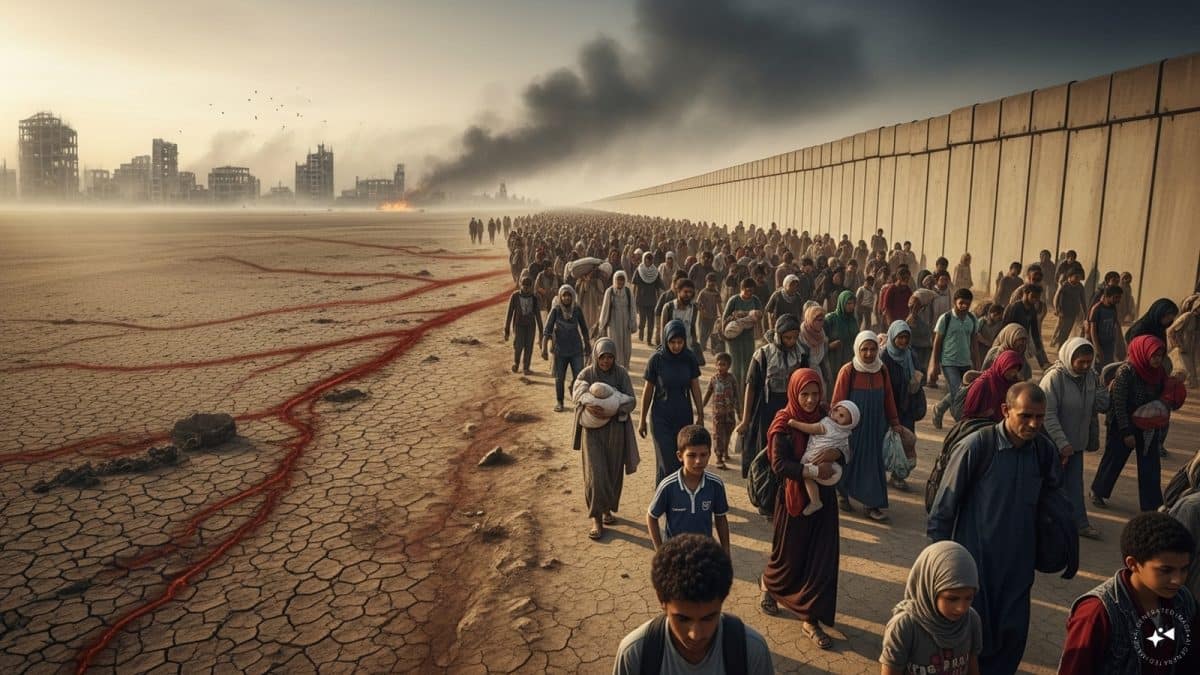
The year 2025 will be etched into history not just for the wars that were fought but for the millions of lives set adrift by them. It was the year when the maps of the world began to bleed across their borders not from conquest but from desperation.
Whether it was the scorched earth of Gaza to the hardened corridors of the US border, the world witnessed a scale of human movement unseen since the aftermath of World War II. It was a year in which compassion collided with a colder era of realpolitik as borders did not merely close but became front lines of a global crisis with human mobility redrawing the world’s map in real time.
STORY CONTINUES BELOW THIS AD
The UN refugee agency (UNHCR) estimated mid-2025 that displacement globally crossed 120 million, a number driven by intensifying wars, political crackdowns and climate shocks.
Afghans in Pakistan face the region’s largest forced returnsPakistan’s 2025 continuation of its mass deportation campaign against undocumented Afghans sparked one of the most severe humanitarian fallouts in South Asia. This year, the forced return of Afghans from Pakistan reached a historic and harrowing peak as the government’s “Illegal Foreigners Repatriation Plan” entered its most aggressive stages.
By late December, the UNHCR and IOM confirmed that over 1 million Afghans were forced back to a homeland currently gripped by a humanitarian crisis and severe restrictions under Taliban rule.
While earlier phases of the crackdown primarily targeted undocumented individuals, 2025 saw the formal expansion of the policy to include holders of Afghan Citizenship Cards (ACC) and importantly, the 1.4 million refugees previously protected by “Proof of Registration” (PoR) cards. This shift effectively dismantled the legal safety net for nearly all Afghans in the country, leading to a surge of over 200,000 returns in November alone, the highest monthly total of the year.
The human rights implications have been devastating with Amnesty International and the UN reporting that roughly 60 per cent of returnees are women and children. Despite international outcries regarding the violation of the non-refoulement principle which prohibits returning people to countries where they face persecution, the Pakistani government proceeded with de-notifying all 54 refugee villages and intensifying police raids and arrests throughout the latter half of the year.
US immigration and a year of hardened bordersIn the United States, 2025 marked a turning point in the politics of immigration after former President Donald Trump returned to office and intensified executive actions. Mass deportation drives, expanded detention and sweeping raids reshaped communities across several states.
U.S.–Mexico border crossings (2020–2025)Annual migrant apprehensions reported by U.S. Customs and Border Protection
2020
0.4m
2021
1.9m
2022
2.38m
2023
2.47m
2024
1.44m
2025
0.24m
Source: U.S. Customs and Border Protection, DHS annual encounter data; compiled from CBP releases and U.S. government reports.
Bloomberg quoted a senior immigration lawyer saying, “This year has placed millions in a constant state of legal limbo even people who have lived here for decades.”
A tightening of asylum pathways and aggressive enforcement at the southern border triggered protests, lawsuits and pushback from state governments and civil rights groups.
Africa’s migration crisis: War climate and governanceAfrica’s migration emergencies deepened sharply through 2025, driven by escalating conflict in Sudan, persistent violence in the Sahel and crippling droughts in the Horn of Africa. The Sudan conflict alone displaced millions more in 2025. The Guardian quoted a humanitarian coordinator saying, “Entire cities no longer exist in the form they did even two years ago.”
Smugglers exploited the chaos, redirecting thousands toward Libya and Tunisia. Risky Mediterranean crossings surged, with the International Organisation for Migration (IOM) reporting another deadly year in the central route.
STORY CONTINUES BELOW THIS AD
Africa’s major migration routes toward Europe (2025)
Central Mediterranean route
Libya & Tunisia → Italy / Malta
Europe’s busiest and deadliest maritime crossing in recent years
↓
Western Mediterranean and Atlantic route
Morocco / Algeria / West Africa → Spain & Canary Islands
Increased crossings via Atlantic routes amid tighter land borders
↓
Eastern Mediterranean route
East & North Africa via Türkiye → Greece / Cyprus
Continued pressure despite stricter maritime patrols
Sources: UNHCR, Frontex, Mixed Migration Centre reports (2025)
Overlooked crises
Somalia: New displacement as drought blended with Al-Shabaab violence
Eritrea: Continued exodus amid compulsory conscription
CAR: Renewed fighting in border regions
Europe and the Mediterranean: A year of shipwrecks and policy shiftsIn 2025, the Mediterranean remained the world’s deadliest migration corridor, defined by a stark paradox: while irregular border crossings into Europe fell by roughly 20% to 22% overall, the mortality rate and the severity of policy shifts reached new extremes.
According to the IOM and UNHCR, over 1,500 people perished at sea this year with a devastating surge in the Central Mediterranean and the Aegean. Various reports highlighted a series of “predictable tragedies’ including a major shipwreck off Libya in November that left 42 missing and several October disasters in the Aegean.
Europe’s 2025 migration policy pivotApril 2025
Proposed “Safe Third Country” list
October 2025
Biometric Entry/Exit System (EES) launched
December 2025
Offshore “Return Hubs” approved
Source: European Commission, Migration Management Cycle Report (Nov 2025)
The year also marked a decisive legislative pivot as Brussels finalised the EU Migration and Asylum Pact, transitioning from a philosophy of “compassion” to one of “external processing.” In December 2025, EU interior ministers approved the creation of controversial “offshore return hubs” in third countries and established a common list of “safe” partner nations—including Morocco and Tunisia—to fast-track deportations. This “Fortress Europe” architecture was bolstered by the October 2025 launch of the Entry/Exit System (EES), a digital border tool replacing physical passport stamps with biometric tracking.
Ukraine: Displacement persists amid a prolonged warAs the full-scale war in Ukraine enters its fourth year, 2025 has been characterised by a “frozen crisis” of displacement where mobility remains high even as the front lines shift slowly.
According to the UNHCR data from December 2025, approximately 5.8 million Ukrainians remain refugees worldwide, with the vast majority, roughly 5.3 million residing across Europe. Inside the country, internal displacement has stabilised at approximately 3.7 million people, though this figure masks a volatile cycle of “re-displacement.”
Fact Box: Ukraine in 2025Refugees Globally: ~5.86 million (as of Dec 11, 2025)
Internally Displaced (IDPs): ~3.7 million
In Need of Aid: 12.7 million people within Ukraine
Key Status: EU Temporary Protection extended to March 2027
Frontline Impact: 89,000+ new evacuations from Eastern regions (June–Sept 2025)
Timeline: 4 Years of Flight (2022–2025)2022: Mass exodus, peak displacement (over 7 million)
2023: Stabilization, slow return, secondary displacement begins
2024: Returns limited, housing shortage persists
2025: Only 1% of population leaving, but overall displaced population remains near record highs
In regions like Kharkiv, Donetsk, and Zaporizhzhia, intensified shelling and the systematic destruction of energy infrastructure throughout the 2025 winter have forced families who had previously returned home to flee once again, creating a layer of “chronic displacement” among the most vulnerable, particularly the elderly and those with disabilities.
The political response in 2025 has shifted toward long-term institutionalization rather than temporary emergency aid. In a landmark decision in June 2025, the European Council agreed to extend the Temporary Protection Directive (TPD) until March 4, 2027, ensuring continued residency and work rights. However, reports highlighted a growing “integration gap,” as host countries like Germany and Poland grapple with fatigue and debate the transition from welfare support to labour market mandates.
STORY CONTINUES BELOW THIS AD
While 90% of occupied Donbas remains under Russian control as of late 2025, the humanitarian focus has pivoted to “winterization” and housing, as nearly 13% of Ukraine’s total housing stock, over 2.5 million homes has been damaged or destroyed, leaving millions with no viable path to return in the foreseeable future.
Gaza & Palestinians: A humanitarian disaster deepensIn 2025, the humanitarian crisis in Gaza transitioned from a state of acute conflict to a catastrophic “frozen” disaster where the breakdown of infrastructure and the environment became as lethal as the violence itself.
Despite a fragile ceasefire brokered in October 2025, UN agencies and the IPC (Integrated Food Security Phase Classification) reported that nearly 1.6 million Gazans (roughly 77% of the population) remained in a state of severe food insecurity by December. While the immediate threat of famine was pushed back in some areas following the truce, the year ended with over 100,000 children and 37,000 pregnant women suffering from acute malnutrition.
STORY CONTINUES BELOW THIS AD
The cumulative death toll surpassed 67,000 Palestinians by late 2025, with health officials warning that “indirect deaths” from untreated chronic diseases and starvation are now rivalling direct casualties.
The physical landscape of Gaza has been fundamentally altered, with the UN Satellite Centre reporting that 83% to 86% of all structures and nearly all cultivable agricultural land have been damaged or destroyed. Displacement has become a permanent condition for roughly 1.9 million people, many of whom were forced to move more than four times throughout the year.
As the 2025 winter set in, the situation turned even more dire; Storm Byron in December destroyed tens of thousands of makeshift tents, causing at least 18 deaths from exposure and building collapses. With 94% of hospitals damaged and the healthcare system “decimated,” the humanitarian response at the end of 2025 is less about recovery and more about basic survival in a territory where the majority of the population is now trapped in “catastrophic” living conditions.
STORY CONTINUES BELOW THIS AD
World Map: Major Displacement Hotspots in 2025Based on the latest UNHCR Global Trends Report and IDMC estimates — over 120 million people were forcibly displaced in 2025.
Key hotspots shown:
West Asia: Syria, Yemen, Gaza — large refugee and IDP flows
Africa: Sudan, Ethiopia, Sahel states — acute internal displacement
Europe & Asia: Ukraine, Afghanistan — protracted and secondary displacement
Latin America & Caribbean: Venezuela, Haiti — cross‑border migration pressures
Sources: UNHCR Global Trends 2025 report; Internal Displacement Monitoring Centre (IDMC) 2025 displacement data.